On my online workbook this week: A hop, skip, and a jump
Dear
This week’s inspiration is Spring absolutely bursting into life.
My design note for you this week is about finding the right spot for your twig to wedge in securely.
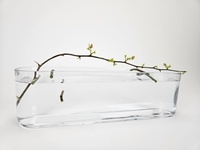
Wedging the stem to fit the diameter of your container is of course a traditional Ikebana technique that allows you to lean your floral material against the opening of a container.
You will need two things: a single short stem that is still fresh enough to have a bit of “give” and a thick walled container that will not crack or break when it is under pressure.
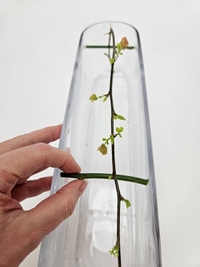
Cut the twig so that it will fit snugly in the opening of the container and then use both hands to position it. You will find that even if you measured the diameter so that your twig fits perfectly it might still be a bit tight (nearly better) or a bit slack (no good at all) at the point where you want to position it.
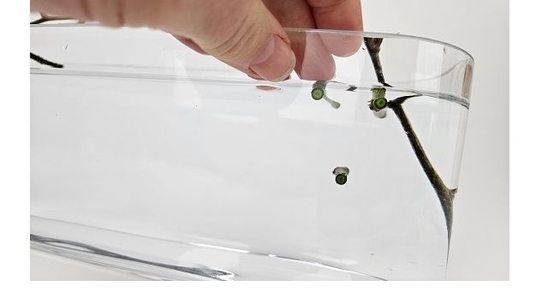
My way is to cut the stem slightly longer than what you will require, slip it into the container so that it fits from side to side and then (and this is where you need to be sensitive to your plant material) move the twig a bit to the end or up or down while holding it on both sides. You will feel where it starts to wedge into place. The sides should just give but not crush. If the stem is crushed it will release bits of debris into the water that will not only spoil the clear aesthetic but also encourage bacterial growth and your design will have a considerably shorter period for you to enjoy it.
Remove any debris with a brush. Brush bristles scoops up faster than anything! And rather remove crushed stems and cut a fresh stem to avoid contaminating the water.
Enjoy!
Every good wish,
Christine
ps: This is also the reason why we no longer recommend hammering woody stems when we condition them. Turns out the branches need those cells that are crushed by hammering to take up water. Water is handed from cell to cell up the stem. And to add insult to injury the bits of hammered stem that is released in the water will contaminate the water and now all your flower material that is arranged with the hammered woody stem is exposed to bacteria.